 Asheville Institute
for Memory & Longevity
Asheville InstituteEducation Initiative
Engineering us in — promoting AI that keeps humans in the loop. AI should enhance human planning, not replace it. We help educators develop engineering curricula that keep humans in the loop with specification-driven skills used by professional engineers. Free, open, and headed into real classrooms this fall.
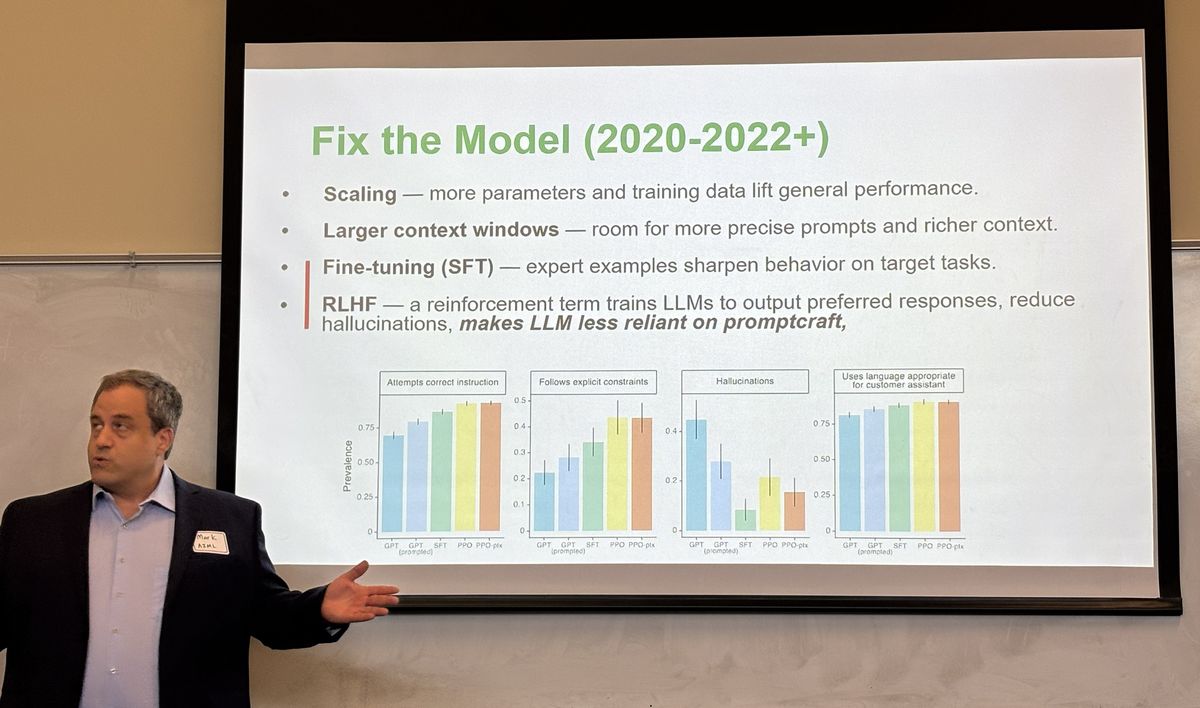
Dr. Mark Dranias presents at the brAIn Hub AI Summit, June 2026.
AI has changed engineering practice, and computer science education has to find a new balance — between the domain fundamentals students have always needed and the human-in-the-loop systems-engineering skills that now make a working system. We don't yet know the right mix. Finding and optimizing it for professional competence is the work.
The open question
Students still need a foundation of domain fundamentals, and they now need systems-engineering skills for directing AI. What ratio produces competent professionals? That balance is exactly what our curriculum work sets out to find.
Our approach
We're not building toward autonomous agents. We design specialized, non-autonomous AI where a well-structured human interaction beats full autonomy — and we teach the complementary engineering skills that make the human-and-machine system work: specifications, constraints, milestones, and review.
Building the field
Beyond the classroom, we encourage engineers to build human-in-the-loop applications — software designed so that people direct and shape the work, rather than hand it over. Better curricula and better tools reinforce each other.
Preprint
A framework for maintaining instructional alignment in LLM-assisted computer science education.
Read on arXiv →Partnership
A signed pilot study of human-in-the-loop agentic programming instruction, run with UNC Asheville and Western Carolina University, with the classroom pilot running in Fall 2026. Operative collaborators: Bill Yang, Yanjun Yan, and Adam Whitley. A broader multi-site study across universities and community colleges follows.
The platform
Instructional labs, a drift-injection library, instructor guides, and grading rubrics. The code is available under a license free for research and individual use; classroom use is offered through collaboration with AIML, and we may license educational institutions in the future.
Follow the project on GitHub →For faculty
Building on our current UNCA and WCU pilot, AIML is gathering institutions for a multi-site study of human-in-the-loop CS education. Partner sites receive tools, training, privacy-protecting telemetry, and study-design support, provided at or below cost. We're glad to discuss what participation involves.
Express interest →Through September 16, AIML is raising funds for AI in education via the 2026 Biltmore Birdies for Charity. 100% of your donation reaches AIML, plus tournament bonus-pool matching.